Compliance
•
2026-06-21
•
By Compliance Team
ISO 20022 and Wullut: Bridging Legacy Banking Systems with Web3 Speed
The global financial system is migrating to the ISO 20022 messaging standard. We examine how Wullut bridges this data-rich standard with high-speed Web3 networks.
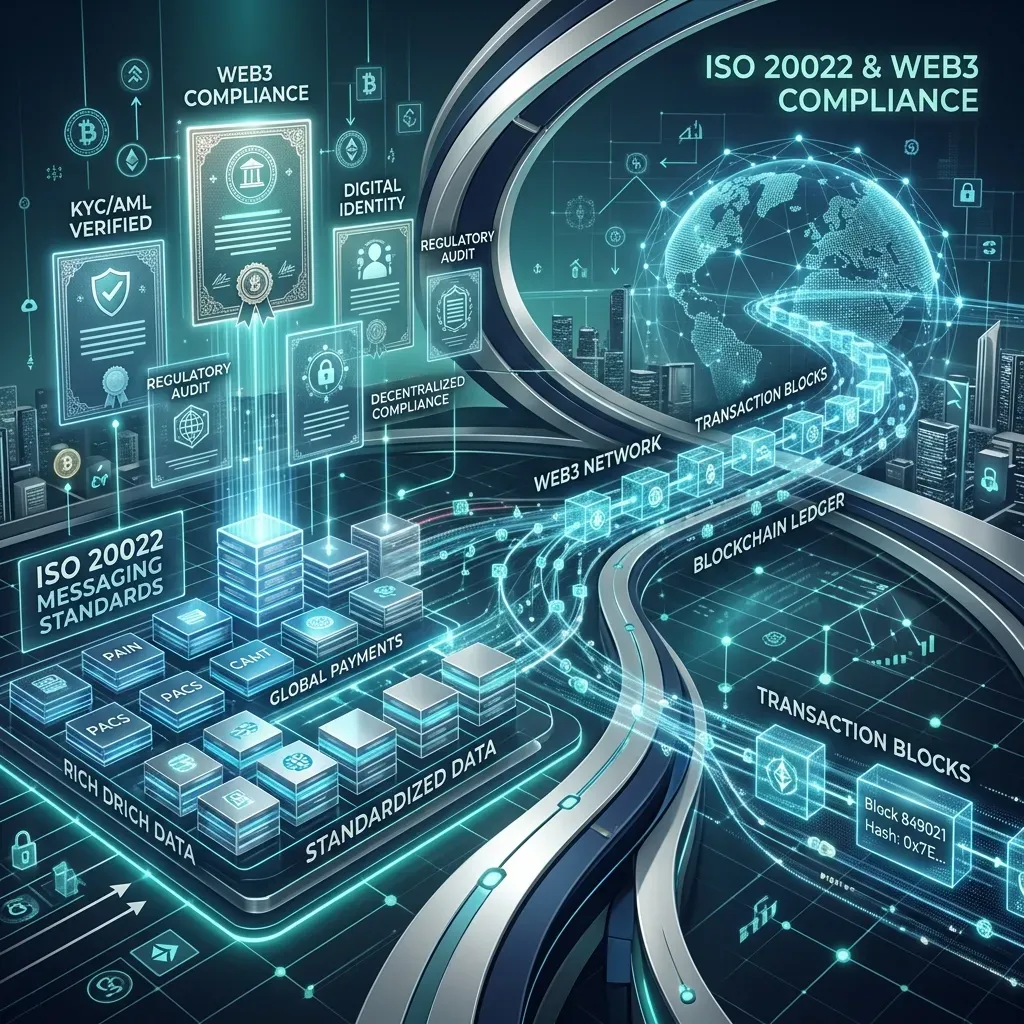
ISO 20022 and Wullut: Bridging Legacy Banking Systems with Web3 Speed
The global financial system is undergoing its largest backend upgrade in half a century. Banks worldwide are migrating from legacy, unstructured message formats to **ISO 20022**—a unified, XML-based data standard for financial transactions.
ISO 20022 allows for significantly richer transaction data, including structural details about parties, remittance info, invoice numbers, and compliance codes.
While banks adopt ISO 20022, Web3 networks are scaling at a record pace. The challenge is that blockhains operate on minimal data payloads to keep transaction fees low.
Wullut resolves this discrepancy by acting as a translation bridge, enabling data-rich legacy banking messages to trigger high-speed, compliant on-chain settlement.
Why ISO 20022 Matters
Legacy SWIFT messaging (MT formats) was developed when computer storage and network bandwidth were extremely expensive. Message fields are truncated and poorly defined, making automated processing and AML compliance check procedures difficult and error-prone.
ISO 20022 introduces structured, standardized fields for:
- Ultimate debtor and creditor details.
- Purpose codes (explaining *why* the money is moving).
- Tax and invoice breakdowns.
- Regulatory reporting markers.
By structuring this data, financial institutions can automate compliance audits, reducing the number of false positives that slow down international payments.
The Web3 Data Challenge
Blockchains like Solana and Ethereum are designed to transfer tokens between cryptographic addresses quickly and cheaply. They are not designed to carry complex invoice metadata or corporate compliance payloads directly on-chain, as doing so would cause transaction costs to skyrocket.
**Wullut's dual-architecture solves this problem.**
Our platform splits transactions into two parallel paths:
1. **The Settlement Layer**: The transfer of fiat-backed stablecoins across Web3 networks for instant, low-cost settlement.
2. **The Metadata Layer**: An off-chain, secure ledger that formats, validates, and stores transaction details according to the ISO 20022 specification.
How the Bridge Works
When an enterprise sends a payment through Wullut:
1. Wullut receives the payment instruction structured as an ISO 20022 file (`p结构.008`).
2. Our parsing engine separates the financial value from the remittance metadata.
3. The value is converted to stablecoins and routed on-chain, resolving in seconds.
4. The metadata is encrypted and stored in our secure, ISO-compliant off-chain repository, linked directly to the on-chain transaction hash.
5. On the receiving end, Wullut compiles the metadata and settlement verification back into a native ISO-compliant message, feeding it directly into the receiver’s ERP system (e.g. SAP or Oracle).
By bridging legacy compliance standards with Web3 architecture, Wullut allows modern enterprises to embrace the benefits of blockchain efficiency without modifying their existing accounting systems.