Compliance
•
2026-10-10
•
By Legal & Compliance Team
Wholesale CBDCs vs. Private Stablecoins: The 2026 Regulatory Convergence
As the Bank for International Settlements (BIS) Project Agora advances alongside full European MiCA enforcement, the debate between CBDCs and stablecoins has resolved into a cooperative two-tier monetary model.
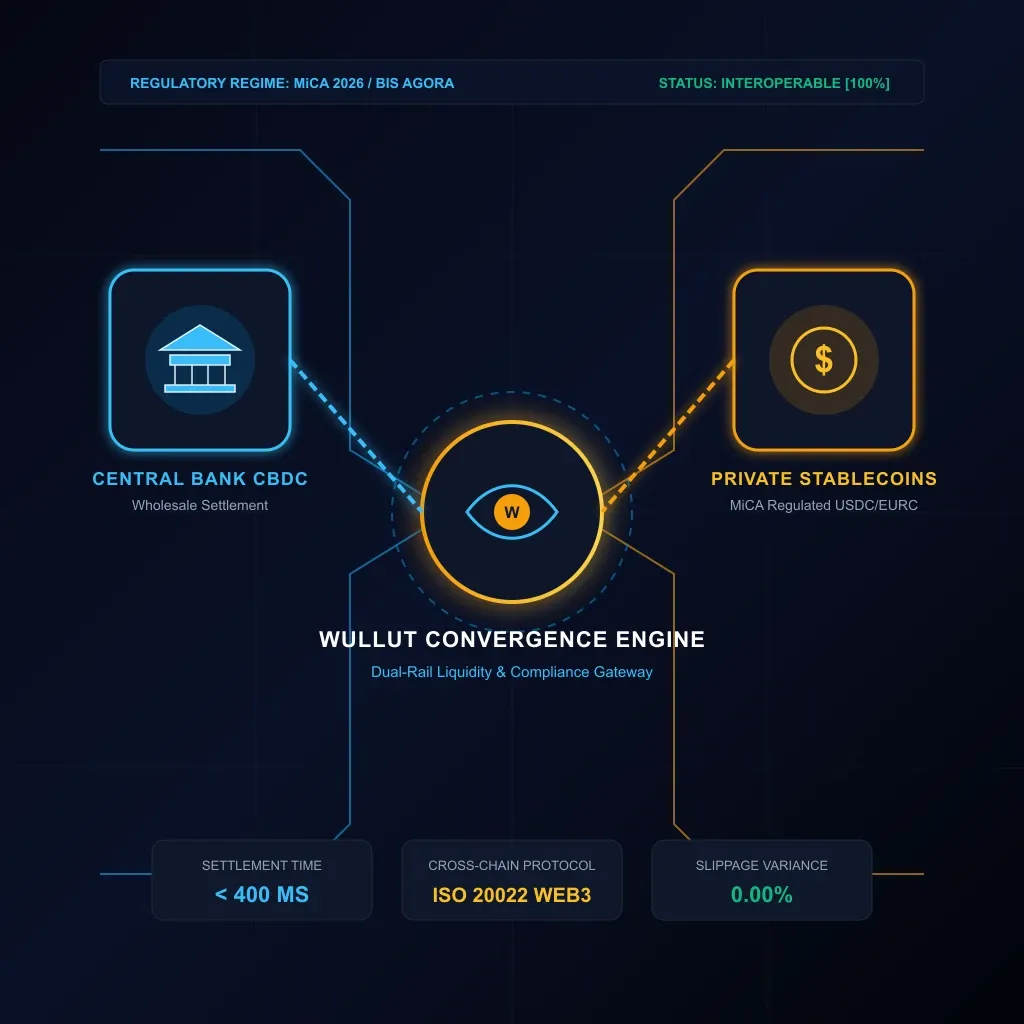
Wholesale CBDCs vs. Private Stablecoins: The 2026 Regulatory Convergence
Between 2021 and 2024, commentators often framed Central Bank Digital Currencies (CBDCs) and private stablecoins as mortal enemies locked in an existential contest for the future of digital money. Skeptics warned that central bank digital currencies would stifle private innovation or surveil individual citizens, while traditional central bankers feared that unregulated stablecoins would erode sovereign monetary policy.
Fast forward to late 2026, and that adversarial framing has been thoroughly debunked. In its place has emerged an elegant, cooperative architecture: the **Two-Tier Digital Monetary System**, formalised through global initiatives like the Bank for International Settlements (BIS) **Project Agorá** and the comprehensive rollout of the European Union's **Markets in Crypto-Assets (MiCA)** regulation.
Here is an analysis of how this regulatory convergence functions and where Wullut fits into the new financial landscape.
---
The Division of Responsibilities
The consensus that crystallized across central banks and financial regulators in 2026 divides digital money into two complementary layers:
| Layer | Primary Asset Class | Primary Function | Key Characteristics |
| :--- | :--- | :--- | :--- |
| **Wholesale Tier** (Interbank) | Wholesale CBDCs / Tokenized Central Bank Reserves | High-value interbank settlement, cross-border FX clearing, lender-of-last-resort stability | Closed network, strictly restricted to regulated credit institutions and central banks |
| **Retail & Commercial Tier** (Consumer & B2B) | Regulated Commercial Stablecoins (e.g. MiCA-compliant USDC / EURC) | Everyday consumer payments, merchant checkouts, programmable smart contracts, automated micro-settlements | Open blockchain protocols, modular account abstraction, composable across Web3 applications |
```
┌────────────────────────────────────────────────────────┐
│ CENTRAL BANK WHOLESALE LAYER │
│ (Tokenized Reserves / Wholesale CBDC) │
│ • BIS Project Agorá Settlement Rail │
│ • Sovereign monetary stability & interbank clearing │
└───────────────────────────┬────────────────────────────┘
│
Direct Regulatory Bridge & API
│
▼
┌────────────────────────────────────────────────────────┐
│ WULLUT COMPLIANCE & LIQUIDITY ENGINE │
│ • Automated ISO 20022 messaging translation │
│ • Real-time Travel Rule & AML screening │
│ • Biometric MPC multi-sig custody │
└───────────────────────────┬────────────────────────────┘
│
Instant Tokenization / Mint-Burn
│
▼
┌────────────────────────────────────────────────────────┐
│ RETAIL & ENTERPRISE COMMERCE │
│ (MiCA-Compliant Stablecoins & Wallets) │
│ • Sub-second consumer merchant checkout │
│ • Programmable corporate escrow & cross-border payroll│
│ • 24/7/365 liquidity with zero counterparty friction │
└────────────────────────────────────────────────────────┘
```
---
Why Retail Thrives on Regulated Stablecoins
Central banks have largely recognized that maintaining consumer-facing payment apps, handling customer support, and providing 24/7 fraud prevention is not their core competency. That responsibility belongs to agile fintechs and digital wallet operators.
Meanwhile, private stablecoin issuers that survived the regulatory winnowing of 2025–2026 did so by adopting the highest prudential standards:
1. **100% Segregated Cash & Sovereign Paper**: 1:1 backed by cash held in central bank reserve accounts or ultra-short-term treasury bills.
2. **Third-Party Real-Time Attestations**: Independent accounting audits published with automated cryptographic proofs of solvency every 24 hours.
3. **Bankruptcy Remoteness**: Complete legal protection ensuring token holders have direct senior claims on reserve assets in the event of any institutional insolvency.
---
How Wullut Bridges Both Realms
Wullut operates at the intersection of sovereign compliance and open-network innovation:
* **ISO 20022 Native Translation**: All transactions passing between wholesale bank clearing systems and Wullut's blockchain rails are formatted into enriched ISO 20022 XML standards (`pacs.008`, `camt.053`), ensuring total auditability for partner banks.
* **Embedded Travel Rule Compliance**: Built-in cryptographic identity verifications transmit requisite originator and beneficiary data seamlessly without compromising user wallet sovereignty.
* **Frictionless Capital Flight Protection**: By working directly alongside licensed European and global Electronic Money Institutions (EMIs), Wullut guarantees that value moving between traditional commercial banking accounts and stablecoin rails is fully insured, compliant, and instantaneous.
The debate is over. The future of money is neither solely central bank-issued nor anarchic crypto; it is a unified, regulated, high-speed ecosystem where both systems work together.