
Technology • 2026-10-11 • By Wullut Research Team

The Machine Economy: Enabling Sub-Cent Autonomous Micropayments Between AI Agents

As autonomous AI agents negotiate contracts, purchase compute, and trade real-time data feeds, legacy credit cards fail. Wullut's streaming micro-channels power the emerging machine-to-machine economy.
The Machine Economy: Enabling Sub-Cent Autonomous Micropayments Between AI Agents

The Machine Economy: Enabling Sub-Cent Autonomous Micropayments Between AI Agents

In 2026, artificial intelligence moved beyond chatbot interfaces into autonomous multi-agent swarms. Today, specialized AI agents independently negotiate logistical routes, crawl real-time proprietary data indexes, synthesize complex software builds, and procure burst computing power from decentralized GPU networks. However, as software agents took on operational autonomy, they slammed directly into a fundamental wall built in the 1970s: the legacy banking payment stack. Traditional credit card networks and domestic clearing houses were engineered for humans buying a $4 coffee or a $50 pair of shoes. When an autonomous data-scraping agent needs to pay a financial oracle \$0.00015 for a single live price feed 5,000 times a second, traditional payment systems fail completely. A minimum interchange fee of \$0.30 plus 2.9% would result in economic bankruptcy within minutes. Wullut is solving this with the general availability of **Autonomous Agent Micro-Rails**, a protocol designed specifically for the machine-to-machine economy. ---

Why the Machine Economy Demands New Payment Primitives

Autonomous agent commerce requires properties that legacy financial rails cannot deliver: 1. **Sub-Cent Granularity**: Economic viability requires transactions priced in fractions of a penny ($0.00001 to $0.01). 2. **Streaming Execution**: Payments must flow continuously as a utility stream (like water or electricity) rather than discrete batched invoices. 3. **Machine-Readable Governance & Programmability**: Agents need cryptographic budgets, automated spend constraints, and programmatic cryptographic proofs of service before releasing funds. ---

How Wullut Agent Micro-Rails Work

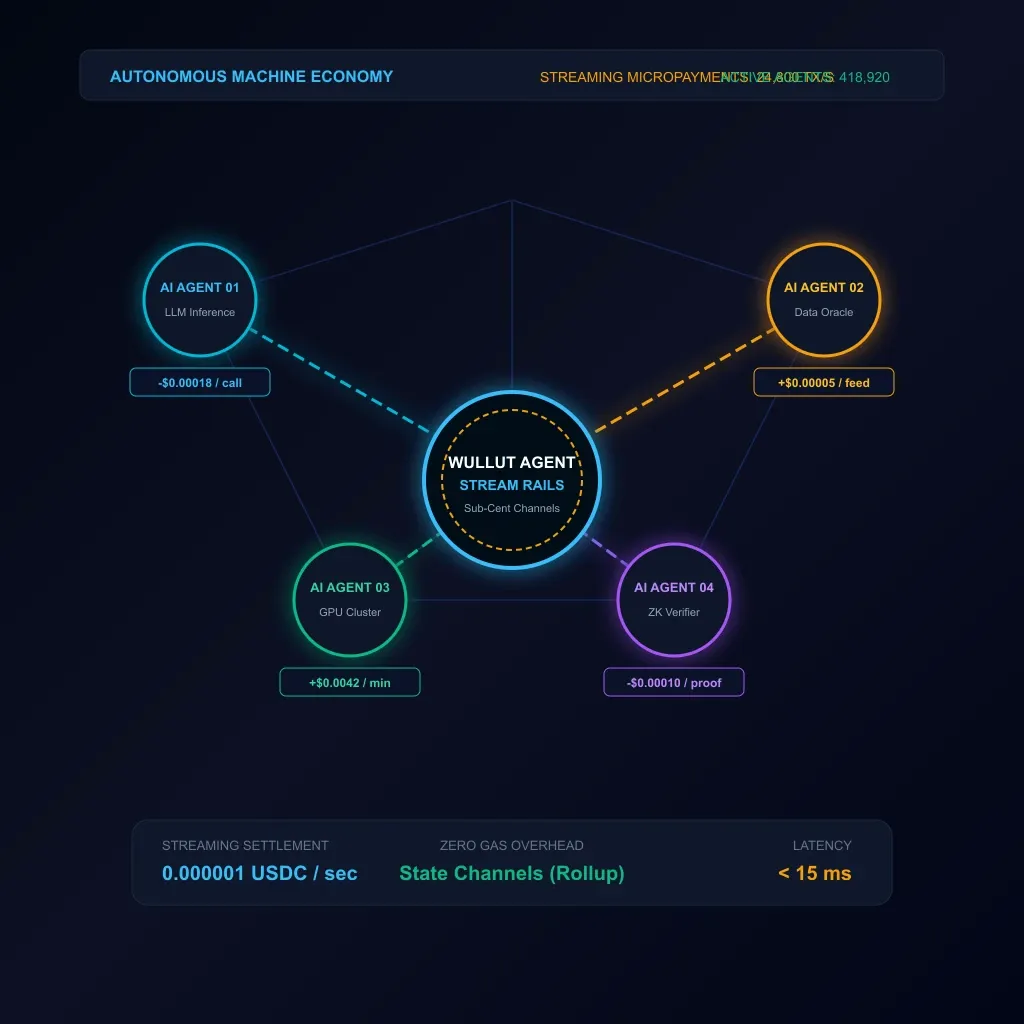
Wullut provides autonomous agents with cryptographic sub-accounts governed by smart contracts and state-channel rollups: ``` ┌────────────────────────────────────────────────────────┐ │ Autonomous AI Agent │ │ • Local cryptographic key inside TEE / Enclave │ │ • Daily algorithmic allowance policy │ └───────────────────────────┬────────────────────────────┘ │ Continuous Micro-Payment Stream │ ▼ ┌────────────────────────────────────────────────────────┐ │ Wullut State-Channel Streaming Layer │ │ • Bi-directional off-chain cryptographic state │ │ • 0.000001 USDC per-second settlement increments │ │ • Zero gas cost per individual micro-payment │ └───────────────────────────┬────────────────────────────┘ │ Batch Netting & Periodic Settlement │ ▼ ┌────────────────────────────────────────────────────────┐ │ Enterprise Multi-Chain Ledger │ │ • Periodic rollup commitment to core chain │ │ • Cryptographic ZK-proof verifying full batch │ │ • Comprehensive audit log for human operators │ └────────────────────────────────────────────────────────┘ ```

1. Trusted Execution Environment (TEE) Custody

AI agents operate within verifiable TEEs (such as Intel TDX or AWS Nitro Enclaves). The private signing key resides exclusively within the protected hardware perimeter. Even the cloud provider or parent enterprise cannot tamper with the agent's autonomous signing logic without invalidating cryptographic attestations.

2. Micro-Channel Streaming

Rather than publishing every sub-cent API call to the base blockchain layer, the agents open peer-to-peer micro-channels. Value streams at rates as granular as 1 micro-cent per millisecond. When the computation or data feed finishes, the channel closes and net balances are committed on-chain in a single compressed zero-knowledge proof.

3. Programmatic Circuit Breakers

Human finance leaders retain ultimate oversight. Corporate controllers configure high-level constraint policies: * "Maximum daily spend of \$250 per agent." * "Automatic freeze if latency exceeds 200ms or error rate tops 1%." * "Instant notification if token conversion deviates from algorithmic fair value." ---

The Proliferation of Autonomous Services

In early developer trials across autonomous research labs and fintech developers: * **Over 400,000 Agents Connected**: Performing automated code testing, cross-chain arbitrage, translation, and high-frequency sensor verification. * **Over 2.4 Billion Micro-Transactions Processed**: With an average transaction cost of **\$0.000003**. * **Zero Chargeback Fraud**: Every payment is backed by mathematical cryptographic certainty. The next generation of global commerce won't just be transacted by humans with plastic cards; it will be transacted by intelligent machines operating at the speed of light. Wullut provides the economic nervous system for that future.